a primordial soup of technological creativity

Friday, July 9th, 2010

During and immediately after World War One, British cryptography efforts were spread throughout a number of different departments. The Army (MI1b); the Navy (NID25, also known as Room 40) They competed for personnel and resources and official favor. They hated each other.

I’m reminded of this, reading Bruce Sterling’s excellent analysis of U.S. attempts to deal with “cybersecurity,” a messy process still in the early stages of developing an infrastructure, which Bruce characterizes thusly: ”A power struggle has been brewing over who should be in charge of national cybersecurity: the NSA, the Department of Homeland Security, the military, or the private sector.”

My primary knowledge about the power struggles that shaped the UK’s Government Code and Cypher School (later Government Communications Headquarters) is derived from my obsession with Alan Turing, who was employed at the GCCS’s main decryption headquarters at Bletchley Park.

The two efforts (pre-World-War-Two British cryptoanalysis and contemporary frantic “cyber-security” scramblings) have some fascinating parallels. They both derived from staggering new technological developments that completely re-shaped the nature of warfare, tossing out the old playbook and pitting entrenched political and military interests against energetic young upstarts, creating opportunities for radical revision. These periodic inversions appeal to the queer anarchist and the community organizer in me, because they create that rare window in which the script is flipped and power dynamics can be meaningfully messed with. How else did someone like Alan Turing, an awkward and delightful little homo who got tossed out of the military once for parsing the wording of a direct order, end up leading a department whose pioneering work “is credited with having shortened the war by two years”? How else did he get the recognition and respect that would get his ideas about machine intelligence taken seriously?

More importantly, these messy interventions create crucibles of knowledge and perspective, where a bunch of different ideas and experiences collide around very specific and challenging problems, and that’s the kind of primordial soup of technological creativity that led to the creation of much of our contemporary communications network. Including, you know, those things Turing sorta invented - what are they called - oh, right - computers. And that other military communications effort. The internet.

And then again it’s entirely possible that I’m being naive and optimistic. That this chaos of corporate and military and political posturing is simply an “almighty mess,” like Bruce says it is, and that you and I are simply “cyberwar cannon fodder for keyboard-punching apparatchiks that you’ll never see.”

But I’m hoping we’ll get something good out of this.

I lost.

Thursday, July 8th, 2010

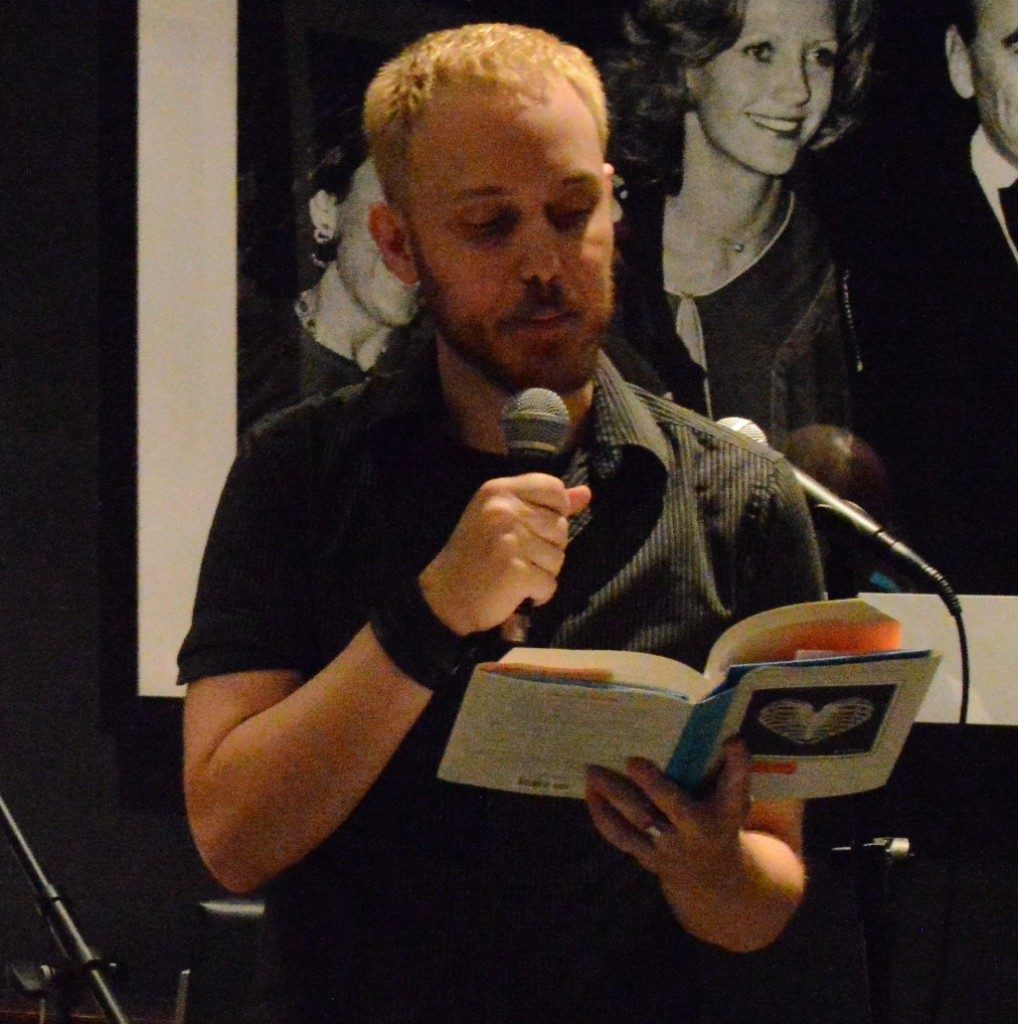
Tonight I was one of the three finalists competing in the finale of the L Magazine Literary Upstart Competition.

I did not win.

But that’s okay! Because the winner was this lady, and her story was terrific. They’re going to run it in the magazine, so keep picking up the L and look out for something by Debora Kuan, because it was pretty fab.

Some marvelous and beautiful and very patient people took me out for a great dinner at Wild Ginger immediately afterward, and the vegetarian bibimbap was amazing, and that also helped soothe the burn of not winning.

If past events are any precedent, the L Magazine website will be full of pictures from last night, so stay tuned for me looking spiffy (I hope) in my kamikaze robot shirt. Here’s a teaser, for now.

The three finalists sit and wait in agony... (photo by Juancy)

The three finalists sit and wait in agony... (photo by Juancy)

…which defies all earthly description…

Wednesday, July 7th, 2010

How many songs are there, in the annals of pop and rock and indie music, about the pathos of the rich man who pays for the artist to create? Commissioning a Symphony in C, by Cake, is the only one I can really think of.

An Austrian nobleman has commissioned a symphony. It is the night of the premiere.

you enter the room with great caution
though no one in the hall is even watching

For the first time, the nobleman is confronted with the thing his money has made. Maybe the composer played a transcription of it for him on the piano, before he approved it… Maybe he heard it in rehearsal. But this is the first time he really MEETS it, really HEARS it, entering the crowded hall, becoming one with this massive audience. Until that moment, he felt like he owned the symphony - it was his, he commissioned it.

with money you squeezed from the peasants
to your nephew you can give it as a present

Not only does he think that the symphony is his, he thinks he can actually give it to his nephew, like a new horse or a piece of land.

And this is the moment where he realizes he doesn’t own it. The nobleman’s pride and ownership evaporates, confronted with the reality of this complex and incredible thing, with the stricken and emotional faces of the crowded theater. He sees it isn’t his. Because no one ever really owns a piece of art.

they are transfixed they are forgetting just to breathe
they are so taken by your symphony in C

I like the phrase “they are forgetting just to breathe;” I assume it means “they are forgetting everything but breathing,” but for me it does a good job of describing that state of awe and rapture to which we are taken by great art - especially non-narrative art like a classical symphony.

Your sitting there thinking your thoughts
they are not about what is but what is not
your sitting there breathing in your breath
you are seldom breathing life, but mostly death

And it’s then, in the moment when the rich and entitled nobleman abandons his ownership of the symphony, that he also accepts his own mortality. In thinking that he could buy immortality, the Austrian nobleman instead realizes, possibly for the first time: He is doomed. He will die. The symphony will not.

It makes me think of T.S. Eliot, in Four Quartets:

…music heard so deeply
That it is not heard at all, but you are the music
While the music lasts.

Great art takes us over, replaces our emotions with its own. Reading the Iliad or Macbeth, watching Citizen Kane or the animated series Avatar: The Last Airbender, we are negated. The emotions and identification that they stir up are eternal. We vanish.

So you`ll be an Austrian nobleman
commissioning a symphony in C
which defies all earthly descriptions
you`ll be commissioning a symphony in C

The last stanza of the song reiterates the first. It focuses again on the symphony itself - the nobleman made of mortal flesh, but the symphony is pure sound, emotion, art, grace, tenderness, ecstasy. Defying all earthly description.

The contemporary analogue to the Austrian nobleman is the record label executive - the guy who puts up the money, who doesn’t have any talent of his own (except the ability to identify and exploit true creativity).

But where is the composer? There’s not one word in there about whoever actually WROTE the symphony.

Because the fate of the artist, in the free market, is to vanish. This is a love song about the song and the man who paid for it - and it’s a tragic love song, because the nobleman is going to die, and the symphony will not.

GDP, Hotness, or Genocide: How do You Choose What World Cup Team to Root For?

Tuesday, July 6th, 2010

Saturday morning in the bar by the lake, seven of us with bloody Marys and chocolate milk and coffee, and we ask each other: how do you choose what World Cup team to root for?

Some people actually like the sport and can recognize game, so they roll their eyes at how shallow we are, but here are my three favorite ways to choose:

1. GDP. Which team got the fuzzier end of the global market lollipop? They deserve to win. So: Brazil over the Netherlands, for example, or Ghana over Uruguay (although that one is maybe tougher to call).

2. Hotness. Which team has the sexiest members? Much more subjective. Germany over Argentina, although it’s a close call.

3. History of Genocide. Which nation’s hands are less bloody? So the USA deserved to lose over Ghana, and Germany deserves to lose to Argentina (although this issue is complicated by the high number of Nazi war criminals who fled to Argentina).

By these hierarchies, who deserves to win it all? Which team has the sexiest guys, or comes from the poorest country, or has gotten massacred a lot more than they have, in turn, massacred? Is there a team from Palestine?

we can’t see the stars

Monday, July 5th, 2010

A long weekend at a friend’s house, upstate, on a lake, Fourth of July so parties rage on all sides of us, drunk hoots and hollers and “Free Bird” and Led Zeppelin echoing across the waters, intermittent illegal fireworks, but out on the dock it’s dark as pitch and the sky is clear, we stretch out on our backs to look up, we see stars, enough that those of us who grew up in the country and now live in the city feel a sudden stab of nostalgia. This sky with all its stars is a birthright we gave up without knowing it.

Weekends like this used to feel like dreams, like short fantasy interludes that broke up the concrete-steel monotony of our everyday life in the city. But lately the script is flipped, and this—this lake, the lapping of cold water, the staggered streak of the Milky Way, the constellations our ancestors built thousands of years ago (because what’s a constellation but an arbitrary grouping of natural objects into an artificial construct, a Greek or Vedic line drawing that survives to the present day), the clatter of acorns falling from trees onto tin roofs, the raw wood of the dock—all of this feels like reality, like the truth, and the city is the dream. The city is the fantasy. The city is the thing that man dreamed up. The city is the place where even water and trees and the sky are fenced in or tied down or carefully controlled or blocked out altogether.

We can’t even see the stars, in the city. What does that tell you? What does that do to us?

The Last Airbender: 25 Word Movie Review

Friday, July 2nd, 2010

Atrocious. Offensive. Don’t know the show? You’ll be baffled. If you DO know the show you’ll JOIN ME IN PLOTTING BLOODY VENGEANCE AGAINST THE FILMMAKERS.

I’m a Finalist - Come Cheer Me On To Victory…

Friday, July 2nd, 2010

On Thursday, July 8th, at 7PM, the L Magazine will be holding the finals of its 2010 Literary Upstart competition, at Spike Hill: “in the heart of Williamsburg Brooklyn at 184 & 186 Bedford Avenue.  Just a few steps away from the Bedford Avenue stop on the L train.”

I was the winner of the first round of semifinals (”a short fiction Thunderdome,” “American Idol-style live readings, wherein selected submitters read in front of a panel of judges (led as always by the New Yorker’s Ben Greenman), competing for their affections, cash, and a place in the L’s annual Summer Fiction Issue”), so if you’re in New York City you should definitely come hear me read my short-short “Men Kill Things.”

For full details, check out the page about it on the L Magazine website.

Facebook Video of My Victorious Semi-Final Performance…

Sexy, by Joyce Carol Oates - 25 Word Book Review

Thursday, July 1st, 2010

Disturbing, but maybe cheaply so. Gee-whiz-ness (mimicking the narrator or reader?) gets tiresome. Evaporates fast. Great palate cleanser for other/denser books. Brilliant touches throughout, obviously.

Robot Pterodactyls vs. Robot Lizards

Tuesday, June 29th, 2010

What a day for robots… two exciting-yet-potentially-terrifying developments (see below, after the Mecha Ridley picture):

via KurzweilAI:

“A miniature glider robot capable of jumping, gliding and perching for search and rescue or detection of forest fires have been designed by researchers at EPFL’s Laboratory of Intelligent Systems… Developer Mirko Kovac, currently a post-doc at UC Berkeley, imagines swarms of his robots equipped with different sensors and small cameras that could be deployed over devastated areas to transmit essential information back to rescue command centers. The robot design is scalable, he says.”

via Smart Machines:

“Natural disasters like earthquakes have always plagued human civilization, causing massive amounts of damage, destroying entire cities, and killing tens or even hundreds of thousands of people. While we are still helpless when it comes to preventing such disasters, researchers have found a way that can help search for survivors - with robotic lizards… Taking another leaf out of nature’s book, a team from the Georgia Institute of Technology is working on a locomotion robot that can swim through hard, yet fluid substances, such as sand or rubble. The 35 centimeter-robot in spandex-covered aluminium segments is powered by six linked motors. It borrows its design from the sandfish, a skink species resembling a lizard, which can dive deep into the sand to escape the heat.”

This is a Syfy original movie begging to be made.

It’s interesting, thinking about the diverse ecology of robotics - the different species that will evolve organically through billions of business and academic research project. I look forward to the day when round little robots clean my floor, pterodactyl robots rescue me from the glacier slope where I’m stranded, a cloud of nano-scanner-robots spy on my meetings, spider robots find my keys when I lose them…

Autopsy on Henri Cartier-Bresson (or at least his retrospective at the MoMA)

Monday, June 28th, 2010

After months and months of seeing the poster on the subway and thinking OH MY GODS I HAVE GOT TO GO SEE THAT EXHIBIT, finally, on the day before it closed, I got my ass to the Museum of Modern Art for their Henri Cartier-Bresson exhibit.

Cartier-Bresson sits near the top, if not AT the top, of my personal photographic food chain. Depends on my mood. Some days you feel like an Avedon. Somedays you feel very Meatyard (more and more, this is my default). Some days, some weeks, some very somber and delicious months, it’s all about Nan Goldin.  So I went into it feeling very primed for a transcendental, epoch-making artistic experience (like with the Francis Bacon exhibit at the Met, or - probably my favorite large-scale museum exhibit ever - the 2002 Avedon retrospective).

Alas, this was not meant to be. The exhibit looked at the entire range of his career, from 1930 through the 1980’s; I was not familiar with his later years, and found the work from that period pretty weak. From the late 1950’s on, I found he lost - almost without a trace - that amazing spark that makes him so amazing, that knack for capturing an entire exuberant, irrepressible world in the middle of bursting into being. A complex, crazy story that only existed for a fraction of a second, and then vanished, but somehow got caught on film. There are exceptions, of course - like this one, from 1956, one of my favorites of his - but the division between Good/Early Cartier-Bresson and Bad/Late was too stark and too depressing.

Two big rooms full of weak work would be enough to sink an exhibit from a lesser artist, but it’s hard to be upset after standing inches away from this, or this. It doesn’t matter that it happened in 1930 - it’s simply the absolute pinnacle of the photographic art form. Or, at least, a certain aesthetic school of photography. This composition, for example - it’s like this is what Velazquez was shooting for, all along - look at the way their heads are arranged in the frame, look at the diversity of facial expressions, look at the multiple planes of focus - like Las Meninas, except it was created in a 60th of a second instead of over the course of years. And this one - what’s the story here? It breaks my heart, although I have no idea what’s happening.

And of course it’s always profound to be confronted with the actual gelatin-silver print of a photograph that you’ve only ever seen in reproductions in books. Little things like the way that when you get up close to it, you see that the print of this one has uneven edges, like it was cut with scissors instead of a blade cutter. Or big things like the way the 1930s fashion for lower-contrast small-scale prints changes our sense of priorities in images that were darker and clearer and sterner when we first encountered them.

So… not a great exhibit. BUT it was worth the trip, because while I was there I discovered THIS BRILLIANT EXHIBIT of photography by women, from Julia Margaret Cameron in the 1860’s all the way up to the present day. Seriously, SO MUCH INCREDIBLE WORK, from all the folks you know and love (Dorothea Lange, Berenice Abbott, Diane Arbus, Maya Deren, Leni Riefenstahl (in all her despicable, aesthetically-compelling Fascist glory), Nan Goldin, Tina Modotti, Cindy Sherman, Helen Levitt, and on and on… but more importantly and more excitingly, it was full of terrific work by women I’ve never heard of, and i had my camera out snapping tons of shots just of the title cards, so I would know who to Google when I got home.

It’ll be good for about a half-dozen more blog posts, at least. So stay tuned. Or better yet: get your ass to the MoMA and see it for yourself. It’ll be there through March 21, 2011.  It’s the kind of thing - like Avedon at the Met - that I’ll want to come back to several times over the course of its run, and experience it differently every time.

That's me and Martha Graham, or at least it's me and Barbara Morgan's 1940 photograph, on display in the MoMA exhibit...

Me and Martha Graham, or at least me and a famous 1940 Helen Morgan photograph.

The New York Daily News: “anti-fag and pro-cop” since 1969 and beyond…

Sunday, June 27th, 2010

41 years ago! Today! The Stonewall Uprising.

Joe.My.God, the brightest journalistic light in the homo heavens, did us a great favor by posting the New York Daily News’ original article covering the event. Required reading. Of course the article is homophobic as hell. That’s not surprising. What’s surprising is how LITTLE the Daily News’ editorial voice has changed. From the punny headline (”Homo Nest Raided - Queen Bees Stinging Mad”) to the reflexive habit of editorializing after every quote (“We’re putting our foot down once and for all.” The foot wore a spiked heel.) to the chummy, chatty presentation of facts in a tone that says “this is clear as day. if you disagree it’s because you’re wrong” ( It was a raid. They had a warrant…. Since the Stonewall was without a license, the place was being closed. It was the law.).

Bad as it is, I was actually a little surprised at how often the article managed to be even-handed. Some great quotes from the queers at the scene, especially the one who told the reporter “I don’t like your paper… it’s anti-fag and pro-cop.” Towards the end, where the general journalistic response is to include a derisive quote from some arbiter of morality, there’s a quote from a mom with two kids who says that the Queens never bothered anybody, they mind their own business, and that “It was just awful when the police came. It was like a swarm of hornets attacking a bunch of butterflies.”

It’s interesting to compare the way queers were discussed in the media back then, with the way homeless people are discussed in the media now. There’s the same condescension, the same blithe assumption that any reader will see things exactly the same way (which is not an assumption but a journalistic strategy that’s useful in convincing people of the truth of something that is patently false… say it with a straight face). Even that is beginning to change from the bad old days when the New York Post wrote editorials like “Vagrants with Laywers” (2003)and “Get The Violent Crazies Off the Street”(1999), and I’d like to attribute a lot of that to the radical, pioneering work of Picture the Homeless, the only group OF homeless people working to challenge stigmatization and stereotypes as well as the root causes of homelessness, but we still have a lot of work to do.

Here’s hoping that sustained agitation and organizing from the homeless will give that community the same quantum leap forward that us queers have made since 1969.

Everything is Code. What does that mean if we want to CHANGE everything?

Saturday, June 26th, 2010

Community organizers obsess over power. Not “how do we get it?” but “how do we destroy it?” Destroy, break, fracture, re-distribute, re-invent. We do this work because we believe that directly-affected communities DO have the power to fix the systemic imbalances that result in oppression and poverty… but we also do it, especially after a couple of years, with a certain degree of cynicism about whether the institutions by which the status quo maintains itself can ever be made just. Maybe we can imagine a criminal justice system that doesn’t screw over people of color so obscenely… but years of experience have made it hard for us to imagine the existing mechanisms of power (elected officials, agency administrators, facility operators) making any of the changes we want to see. Or when change does happen it’s at a glacial pace, with every step forward taking literally years - the victory of the Domestic Workers Bill of Rights, after six hard years of brilliant organizing, is a great example of that.

Which isn’t to say we should stop - just that community organizing is ONE OF many strategies that’s needed. More and more I’m wondering: what role can technological direct action play in creating systemic change?

I’m not talking about MoveOn.org-style online organizing. I’m talking about code interference intended to disrupt the function and administration of oppressive systems.

Looking at it from that perspective, this new article becomes particularly intriguing - from The Technology Review, Moore’s Outlaws, by David Talbot:

“Code is more complex, and that means more opportunity to exploit the code. There is more money to be made in exploiting the code, and that means there are more and more sophisticated people looking to exploit vulnerabilities.”

The article talks mostly about criminal interference - hackers, etc. And when he does discuss political cyber-interference, it’s generally carried out by some big scary players: the Chinese government, the Russian government (or, at the very least, the hacking advances the interests of those players, and punishes their enemies, even if it’s not at all clear if the attacks were carried out by the governments themselves or by zealous and patriotic computer geniuses…. but if suddenly the Dalai Lama’s email account is hacked and all his contacts find their computers wiped clean, I don’t imagine he sees much of a difference whether it was Beijing or just an enterprising lone cyber-gunman).

Looking Talbot’s outlaws, it’s fascinating to think about how direct action shaped by the demands of low-income people and backed up by solid technicians, carried out in cyberspace, could mess with business as usual… disruptions that could be carried out against BP and Monsanto as much as the U.S. Government; Scientology as much as terrorist networks. Wikileaks is a brilliant example, but the potential is so much wider. Think about how much of the work of governments is carried out through software - and therefore mediated by code: emails, logistics, distribution, coordination of massive amounts of resources. Think about how code can flip the script, so that “a small, committed group of people,” instead of distributing flyers outside a government agency office, can shut the office down for the day. Think about all the delicious new openings for subversion from below.

Everything is code. So let’s get to work.

If anyone had the money and the crazy to fake his own death, it was Michael Jackson.

Friday, June 25th, 2010

June 25, 2009. Walking home from work, down Fordham Road, through heat that’s more than heat, I hear it, again and again: the bassline from Billie Jean. From the insides of stores, from the rolled-down windows of cars stopped at red lights. Is everyone listening to the same radio station? Is every radio station playing the same thing? Did everyone spontaneously dial their MP3 players to the same song? Is Billie Jean on the MP3 player of absolutely everyone in the Bronx? It’s on mine.

And what a brilliant bassline it is: insistent, steady, coiled, lurking, like a rattlesnake whose venom causes an exquisite sensation between ecstasy and despair. This is the 1980’s, stuffed into seven repeating notes. Moving through the Bronx end-of-day crowds, I can see it in all of our faces: adapting to a world without Michael Jackson.

A gossip site everyone used to make fun of broke the most important entertainment story of the summer. Everyone’s texting everyone. Michael Jackson is dead. Everything is over. Tina’s Facebook status sums it up best, something along the lines of: “Michael Jackson was the kid everyone was mean to. And now he’s dead and everyone feels like shit.”

Although J. and I are not so sure. If anyone had the money and the crazy to fake his own death and move to Dubai and live in princely cloistered seclusion, it’s Michael Jackson. And the King of Pop’s first year “dead” was a productive one - Joe.My.God is reporting that his estate netted a billion dollars since a year ago today.
Michael! If you’re out there - if you’re spending this momentous day wrapped in a chinchilla Snuggie in an air conditioned room seventy stories above the desert heat, Googling yourself and reading laments from all over the world - I hope you’re enjoying your living after-life. You earned it.

Robots will save economy; win war on drugs. Wait, what?

Thursday, June 24th, 2010

Santa Claus came early, and he brought unmanned aerial drones.

These flying robots, semi-autonomous and semi-remote-controlled, pumped out by aerospace/defense contractor Northrop Grumman, are bringing joy and happiness to the American heartland.

Over at Alternet, the brilliant Laura Flanders is reporting on recent mega-million-dollar contracts to create “drone base controls”; it’s hyped as a sure-fire job creator, and local communities in Wisconsin and Missouri and South Dakota are rejoicing. It’s nice that folks can get jobs, but it would also be nice if there was money to create jobs that didn’t in turn create “the charred flesh of children killed by accident, by remote.”

Meanwhile, the US Department of Homeland Security “will deploy additional Border Patrol agents, ICE investigators, two drone aircraft and other technologies to its border with Mexico as part of a new effort to combat organized crime and illegal immigration…. In the Texas-Mexico border, two additional Predator drones will patrol the area and nearby areas in the Gulf of Mexico region, once Congress approves the 500 million dollars President Barack Obama has requested for such purpose.”

500 million dollars for two Predator drones? Those are some expensive robots!

These border deployments amount to a proxy war between defense contractors and drug cartels, with the government handing out massive wads of cash. Corporations and organized crime - these are the new epicenters of power. Fiscal insolvency is leading to the “erosion of the nation-state’s power to protect/advance the well being of its citizens;” an abandonment of political power for the sake of financial power. That’s the point of the Bush tax cuts and Reaganite policies in general; to take away the power of government to help people (de-funding and demolishing public education, housing, health care, unemployment, etc), and turn government into a funnel for money - out of taxpayers’ pockets and into the hands of businesses and foreign militaries and the “right kind” of global insurgents, the ones resisting governments we don’t like, the ones who probably hate us but will take the cash and weapons we throw at them and then use them on us ten or twenty years down the line.

At the U.S. Social Forum there’s a workshop on “Challenging Robotic Empire.” I’m sad I’m not in Detroit to check it out, but it’s good to see that anti-militarism folks in the US are already thinking through the ways in which military robotics will change the nature of warfare, and therefore the nature of our response to it. I’m hopeful that as we learn how to respond to the new challenges posed by soldier-robots, we take it as an opportunity to take radical anti-militarism work in a new direction…

Poverty/Oppression vs. Resources… what’s the relationship? and where is resistance most effective?

Wednesday, June 23rd, 2010

Looking at oppression and resistance on the global scale, it’s tempting to look at a nation like Haiti and think that poverty and oppression are a consequence of lack of resources. But then, looking at other nations - particularly in Africa - it’s the exact opposite.

In Impact Lab’s recent “20 Failed States Report,” I found this fascinating quote: the Democratic Republic of Congo is “blessed with perhaps the world’s single most abundant, diverse, and extractable supply of minerals.” Yet the country has “one of the world’s most desperate humanitarian situations,” with millions dying from disease and conflict.

And when I visited the Dominican Republic in 2008, after hearing stories from Dominican immigrant friends about how impoverished the country was, I was shocked to see an incredible richness of produce: plantains and mangos and bananas and rice everywhere you looked, growing in astonishing abundance. Poverty and hunger were very real and very obvious, even among so much food production.

The open market turns resources into a liability. The Congo’s richness attracted brutal colonialist exploiters for centuries, and after the colonialists came corrupt local government and violent insurgents and corporate parasites, leading to a brutal war that’s still raging. Farmers in the Dominican Republic are like any other merchant; they’re going to sell their goods wherever they’ll fetch the highest price. And US corporations can pay a lot more than their own neighbors.

So what are we going to do about it? How can the poor flip the script of global exploitation and underdevelopment? The deck is so clearly stacked against outright revolution or non-compliance with market capitalism, going back to Haitian independence - the big powers have a lot of weapons and long memories - if anything, developed nations and major corporations are eager for domestic instability, as it gives them an excuse to take by force what they had formerly needed to haggle and barter and bribe away.

But what disruptive opportunities are created by new technologies? Lately I’ve been thinking a lot about John Robb’s theories around deviant economies, networked tribes, coercing organizational hierarchies, and resilient communities; including some speculations on potent coercive tools for non-violent protest (in a post-Gandhi world).”

I’ve got nothing particular to add, except that us community organizers and activists in the developed world need to start reading a lot more blogs and talking to a lot more folks, from all corners, from corporate consultants to hill-country insurgents to hackers. All voices in the choir, as James Baldwin said.